
Fintech Fran

Robinhood vs Coinbase
If you invested $1,000 in Robinhood at its IPO, it would be worth about $3,030 today, up roughly 203 percent. That same $1,000 invested in Coinbase would be worth about $990, basically flat since IPO.
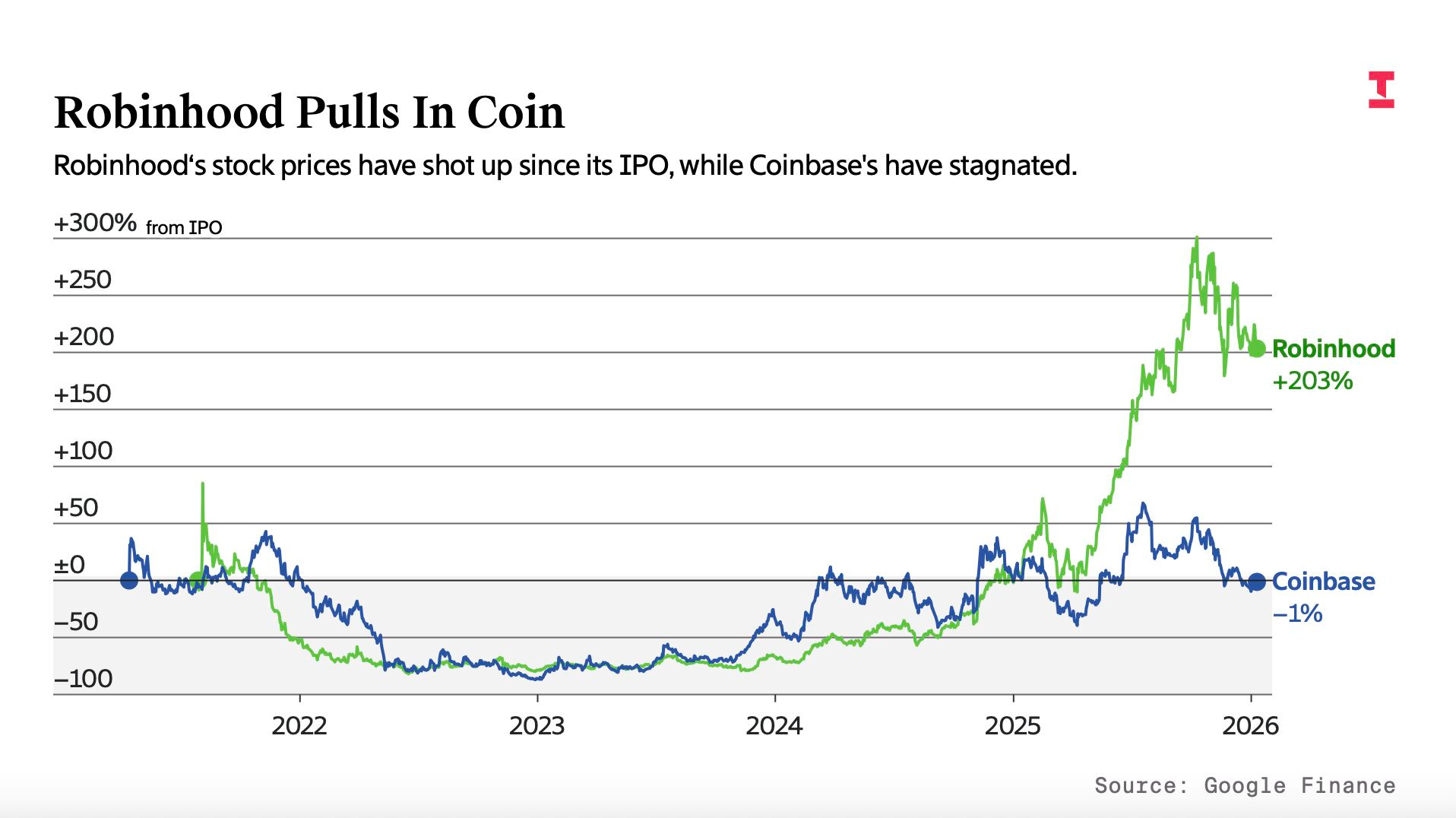
Robinhood and Coinbase started from different places. Robinhood was built for stocks. Coinbase was built for crypto. Today, they are moving into each other’s territory. Coinbase is launching stock trading. Robinhood is expanding deeper into crypto. Both are also betting on prediction markets. On paper, they now look like direct competitors offering similar products to the same users.
The key difference is engagement. Robinhood has around 15–16 million MAU, while Coinbase has about 8–9 million monthly transacting users. Robinhood users trade more often. They use stocks, options, and now crypto, which creates daily habits. Coinbase is still mostly crypto-driven. Crypto trading is more cyclical and less frequent, so users come and go with the market. Coinbase is starting to launch stock trading, which could change this over time, but today Robinhood clearly wins on frequency and engagement.
My guess is that Coinbase will catch up. Even with fewer MAU today, it has a much larger total user base. If Coinbase can activate those users and pull them into more frequent use, the upside is big. Expanding into stock trading, prediction markets, and other financial products could increase engagement and smooth out crypto cycles. If that happens, Coinbase could start to look much more like a full financial platform, not just a crypto app.
Global Fintech Funding
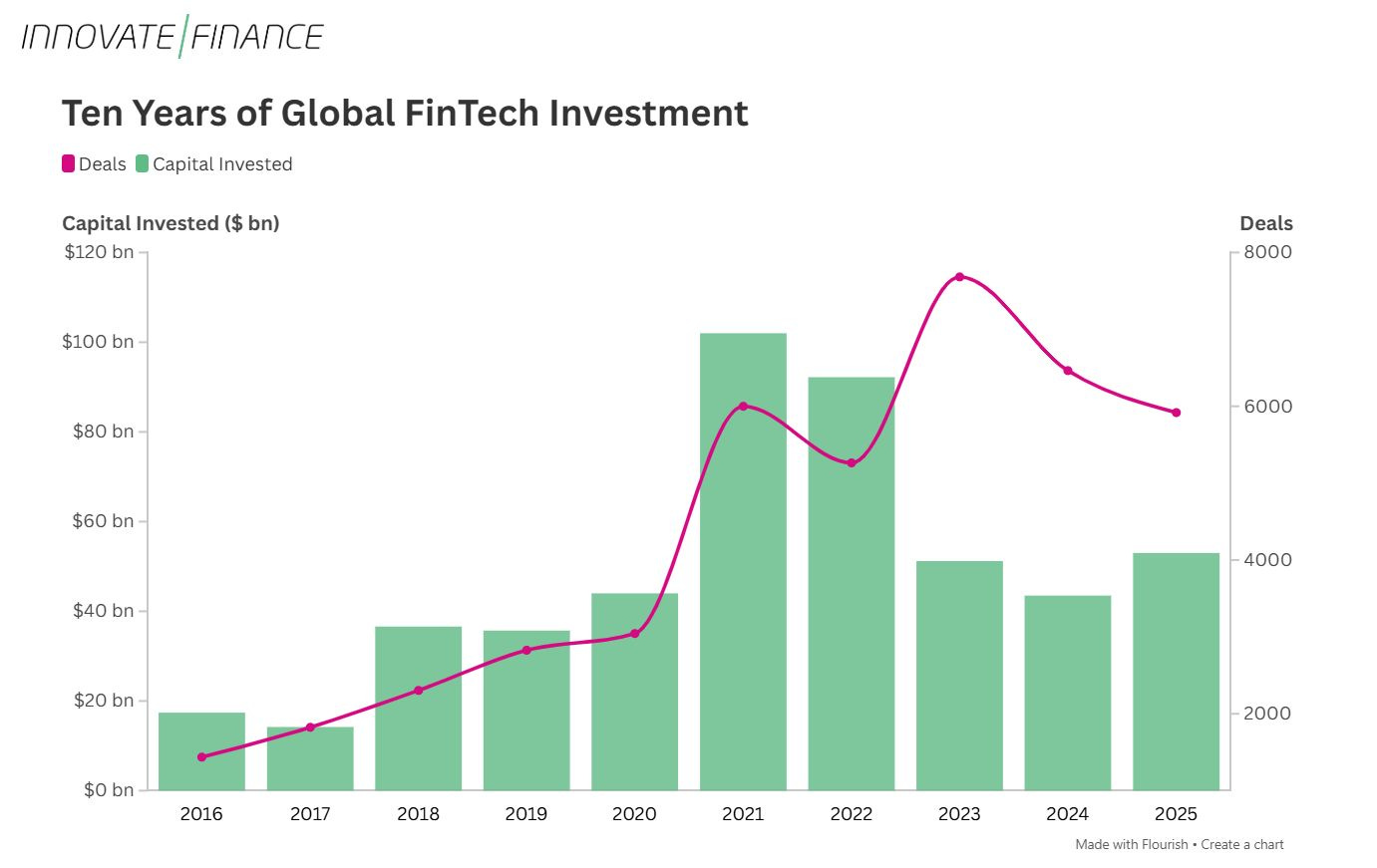
Global fintech funding bounced back in 2025, with $53 billion raised, up 21 percent from 2024, across 5,918 deals. The United States stayed far ahead, pulling in $25.1 billion, followed by the United Kingdom with $3.6 billion, India with $3.4 billion, the United Arab Emirates with $2.5 billion, and Singapore with $2 billion. The biggest rounds show where scale is forming: Binance raised $2 billion in the UAE, Ramp raised $1 billion in the US, Kraken raised $800 million, FNZ raised $650 million, and PhonePe raised $600 million. Fewer deals than the peak years, but more capital going to large, proven platforms. This number will grow in 2026.
Credit Card Cap Rate
The US Administration proposed a 10 percent cap on credit card APR and it sounds like consumer protection, but credit cards run on cross-subsidies. Rewards, lounges, and credits exist because someone else is paying 20–30 percent interest. The system does not get fairer, it rebalances. Rewards get devalued, perks shrink, annual fees rise, and approvals tighten. Premium cards survive, but they become more pay-to-play. Subprime cards stop making sense, which cuts access for people who rely on them most. I agree that Visa and Mastercard have a duopoly on credit cards but the way of restricting profits is not good for the market.
We have seen this logic before in healthcare. Under Obamacare, insurer margins were capped in the 15–20 percent range. Insurers adapted. Networks narrowed. Deductibles went up. Costs shifted elsewhere. Coverage expanded, but prices kept rising. The product survived, but it made prices skyrocket. A credit card APR cap would likely do the same. Banks and fintechs will adapt. Debit-first products may win. But credit does not become cheaper. It becomes scarcer, simpler, and less flexible, especially for the people the policy is meant to protect.
State of Fintech 2026
I recently came across to what I considered the best Fintech report for 2026.
Some of the great insights from this long read are:
Fintech is entering its “compounder” era.
Hyperscalers like Nubank, Klarna, Revolut, Stripe, and Robinhood are no longer disruptors. They compound through distribution, product velocity, and global expansion, leaving many legacy incumbents behind.Scale is no longer the moat, distribution and speed are.
Traditional advantages like brand, licenses, and balance sheets matter less than fast shipping and constant product launches. Companies like Robinhood and Revolut win mindshare by shipping monthly and owning the narrative.AI is already a top-of-funnel commerce channel.
One in six Black Friday purchases was AI-assisted, and traffic from ChatGPT converts 2–6× better than traditional search. AI is not just productivity—it is becoming a demand-generation and checkout surface.Agentic commerce is the next payments battlefield.
Checkout is moving into LLMs, not websites. Whoever controls agent-to-merchant payment protocols may earn a new “digital tax” similar to app stores or ad networks.Stablecoin growth is real and no longer speculative.
Stablecoin volumes are decoupling from crypto prices and growing rapidly, even if still small relative to card networks. Visa already reported billions in stablecoin-linked TPV, signaling early but real adoption.Stablecoins are a B2B infrastructure story, not a consumer one.
The fastest growth is in payouts, treasury management, and trapped liquidity—not retail payments. Wherever money gets stuck across borders or time zones, stablecoins win.Onchain yield is becoming the killer app.
The use case is shifting from inflation hedging and remittances to earning yield on stablecoin balances. Neobanks and enterprises will increasingly embed onchain earn and borrow as standard features.Banks are not disrupted, they’re regrouping.
Big banks are generating record profits, deposits have stabilized, and capital markets are back. Rather than dying, banks are selectively coming onchain via tokenized deposits and custody.Everyone wants to be a neobank, and wallets are winning.
BNPL players, brokerages, crypto wallets, and Big Tech are all converging on the same endgame: owning the primary financial relationship. Stablecoin rails dramatically lower the cost of launching global neobank-like experiences.Consumer financial stress is the silent macro risk.
Assets inflate faster than wages, home ownership drifts out of reach, and student debt keeps rising. This fuels financial nihilism, speculation, and demand for alternative products like prediction markets and onchain yield.
2026 Predictions
Here are my predictions (some non-tech related) for 2026:.
Gemini catches up in the AI race and surpasses OpenAI
A major tech company (Meta, Google, ByteDance, Amazon, etc.) launches its own stablecoin and achieves meaningful adoption
One big IPO. My guess: SpaceX, OpenAI, Stripe, or xAI
Spain wins the World Cup
M&A activity among 2 top LLM players
Nubank acquires a U.S. fintech to launch operations quickly in the U.S.
A new, crazy AI use case emerges
A major dictator falls in 2026 (besides Maduro)
Bitcoin reaches a new all-time high
What do you think? What are your predictions for 2026?
I enjoy writing these pieces and would love your thoughts, what would you change?